CASE STUDY
Rebuilding the EU ETS1 Calculator with River
How Climact replaced a legacy Excel model with a structured, auditable engine, ready for EU legislative negotiations in 2026.
CLIENT
Climact SA
SECTOR
Climate Policy & Regulatory Analysis
DELIVERABLE
EU ETS1 scenario calculator, 2005–2040
7+
Policy levers modeled
35yr
Model horizon
10
Model users
A high-stakes model on a robust foundation
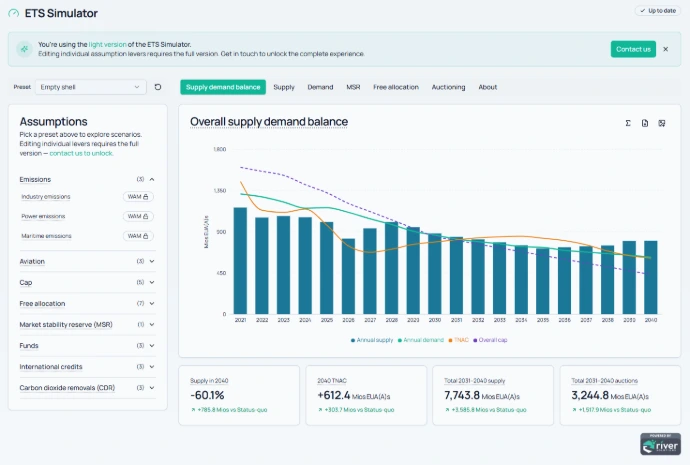
The EU Emissions Trading System (ETS1) is one of Europe's most consequential climate policy instruments. In 2025, the European Climate Foundation engaged Climact — a Brussels-based climate consultancy — to build a calculator that lets policymakers, NGOs, and analysts test how different design choices affect the EU's ability to meet its 2030 and 2040 climate targets.
The model had to cover 35 years of allowance supply and demand, simulate seven interlocking policy levers simultaneously, and survive multiple revisions — shareable in both Excel and a public web tool. Climact's prior version, built in standard Excel formulas, was not robust enough to handle this. Climact decided to use River and its innovative modeling technology and build a new visual, robust and documented model in Excel.
Iterative logic, interdependencies and complex scenarios
The ETS1 model is not a simple calculation chain. Supply in any year depends on the cap — itself altered by MSR inflows, New Entrants Reserve drawdowns, and scope changes. The Cross-Sectoral Correction Factor is a function of total cap versus gross demand. The cumulative surplus compounds year by year and feeds back into MSR trigger logic.
Formula chains spread across a dozen sheets. Complex cell-specific formulas. Adding a scenario meant duplicating entire sheets. Auditing the model took days and still left gaps.
The full model — from raw emissions to per-member-state auction revenues — is a visual Model Map any team member can read immediately. Scenarios are configurable. The iterative logic is transparent and robust.
Four capabilities that weren't viable before
Two modelers, 10 users
Climact brought two climate policy consultants onto the ETS1 model. Neither had used River before. Because River's operations map directly to how analysts think about data, both were productive within their first week — no new programming language or database concepts required.
"The visual schema means the next person who touches this model doesn't need to reverse-engineer it. The logic is there to read."
Simon Lalieu, Senior Consultant, ClimactThe Model Map also serves as living documentation — always in sync with the model itself, no separate diagram to maintain.
A model the whole coalition can rely on
The rebuilt ETS1 calculator was delivered ahead of the Commission's Q3 2026 legislative proposal. It serves three audiences simultaneously: Carbon Market Watch analysts running the full Excel model, ECF stakeholders accessing predefined scenarios via a public web tool, and Climact's team updating it as new positions emerge from the Commission, Parliament, and Council.
A high-stakes model on a robust foundation
The EU Emissions Trading System (ETS1) is one of Europe's most consequential climate policy instruments. In 2025, the European Climate Foundation engaged Climact — a Brussels-based climate consultancy — to build a calculator that lets policymakers, NGOs, and analysts test how different design choices affect the EU's ability to meet its 2030 and 2040 climate targets.
The model had to cover 35 years of allowance supply and demand, simulate seven interlocking policy levers simultaneously, and survive multiple revisions — shareable in both Excel and a public web tool. Climact's prior version, built in standard Excel formulas, was not robust enough to handle this. Climact decided to use River and its innovative modeling technology and build a new visual, robust and documented model in Excel.
Iterative logic, interdependencies and complex scenarios
The ETS1 model is not a simple calculation chain. Supply in any year depends on the cap — itself altered by MSR inflows, New Entrants Reserve drawdowns, and scope changes. The Cross-Sectoral Correction Factor is a function of total cap versus gross demand. The cumulative surplus compounds year by year and feeds back into MSR trigger logic.
Formula chains spread across a dozen sheets. Complex cell-specific formulas. Adding a scenario meant duplicating entire sheets. Auditing the model took days and still left gaps.
The full model — from raw emissions to per-member-state auction revenues — is a visual Model Map any team member can read immediately. Scenarios are configurable. The iterative logic is transparent and robust.
Four capabilities that weren't viable before
Two modelers, 10 users
Climact brought two climate policy consultants onto the ETS1 model. Neither had used River before. Because River's operations map directly to how analysts think about data, both were productive within their first week — no new programming language or database concepts required.
"The visual schema means the next person who touches this model doesn't need to reverse-engineer it. The logic is there to read."
Simon Lalieu, Senior Consultant, ClimactThe Model Map also serves as living documentation — always in sync with the model itself, no separate diagram to maintain.
A model the whole coalition can rely on
The rebuilt ETS1 calculator was delivered ahead of the Commission's Q3 2026 legislative proposal. It serves three audiences simultaneously: Carbon Market Watch analysts running the full Excel model, ECF stakeholders accessing predefined scenarios via a public web tool, and Climact's team updating it as new positions emerge from the Commission, Parliament, and Council.
Get started with River
Install the trial version and test it for 14 days or let us walk you through a demo.